

Every course on the internet teaches the same thing: the order block holds, buy the retest. Put it on a chart and watch what actually happens — the zone is eaten and price keeps going, taking the retest buyers with it. This system is built on the other side of that mistake. It trades the break, and it shows you every one it refused.

An order block marks where a move began — which means it marks where orders were left behind. Those orders are what price returns for. Once they are filled there is nothing holding the level, and the move continues straight through it.
So the retest is not the entry. The break is. A bullish block breached downward opens a short; a bearish block breached upward opens a long — with entry, stop and three targets attached to the candle that broke it.
Nothing in the system is tuned to an instrument or a timeframe. Point it at oil, an index, a stock, a currency pair or the Bitcoin daily and the behaviour is identical: a block is consumed, the position opens in the direction of the break, and the ladder is measured from the volatility of that instrument at that moment.
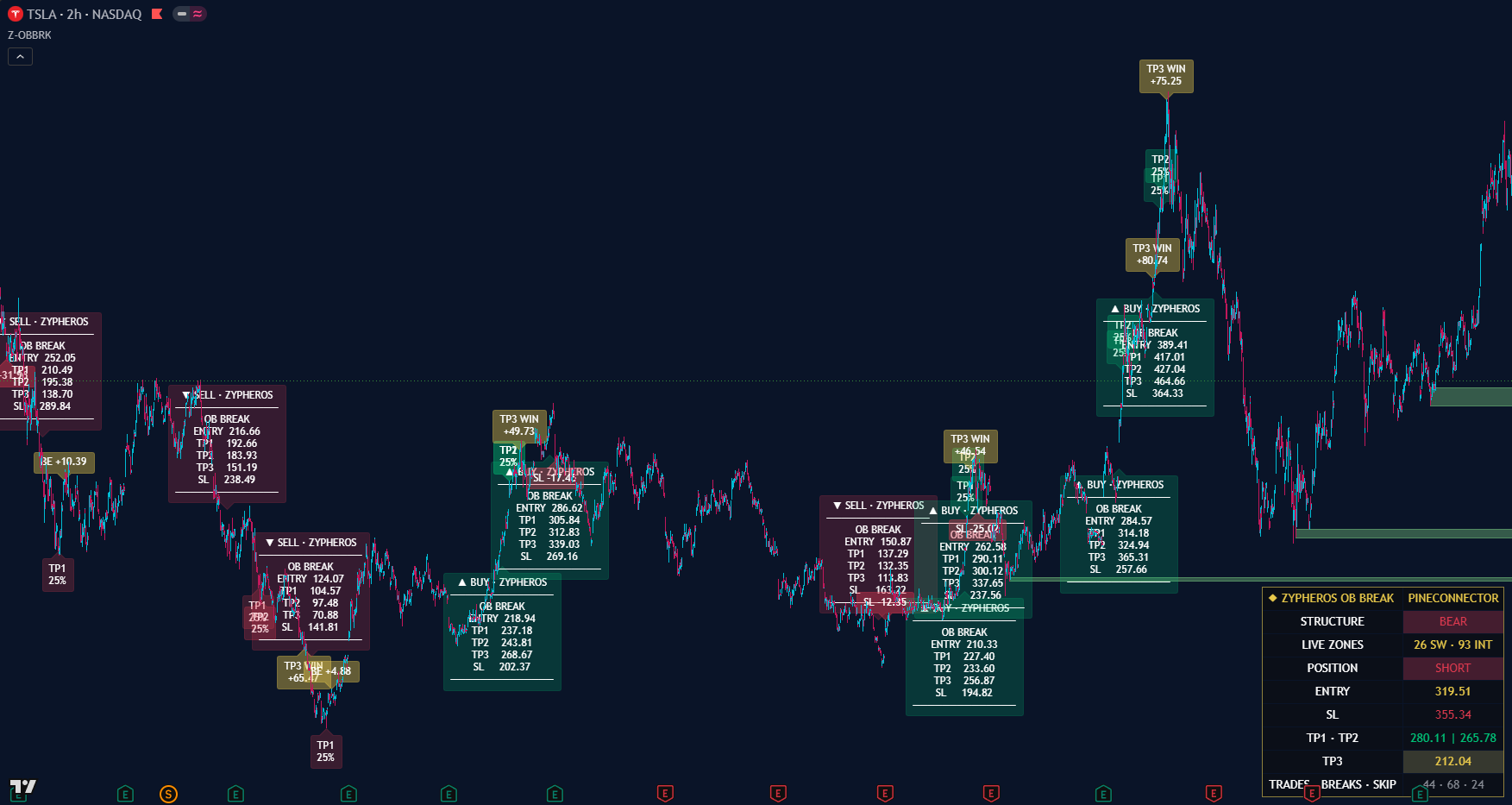
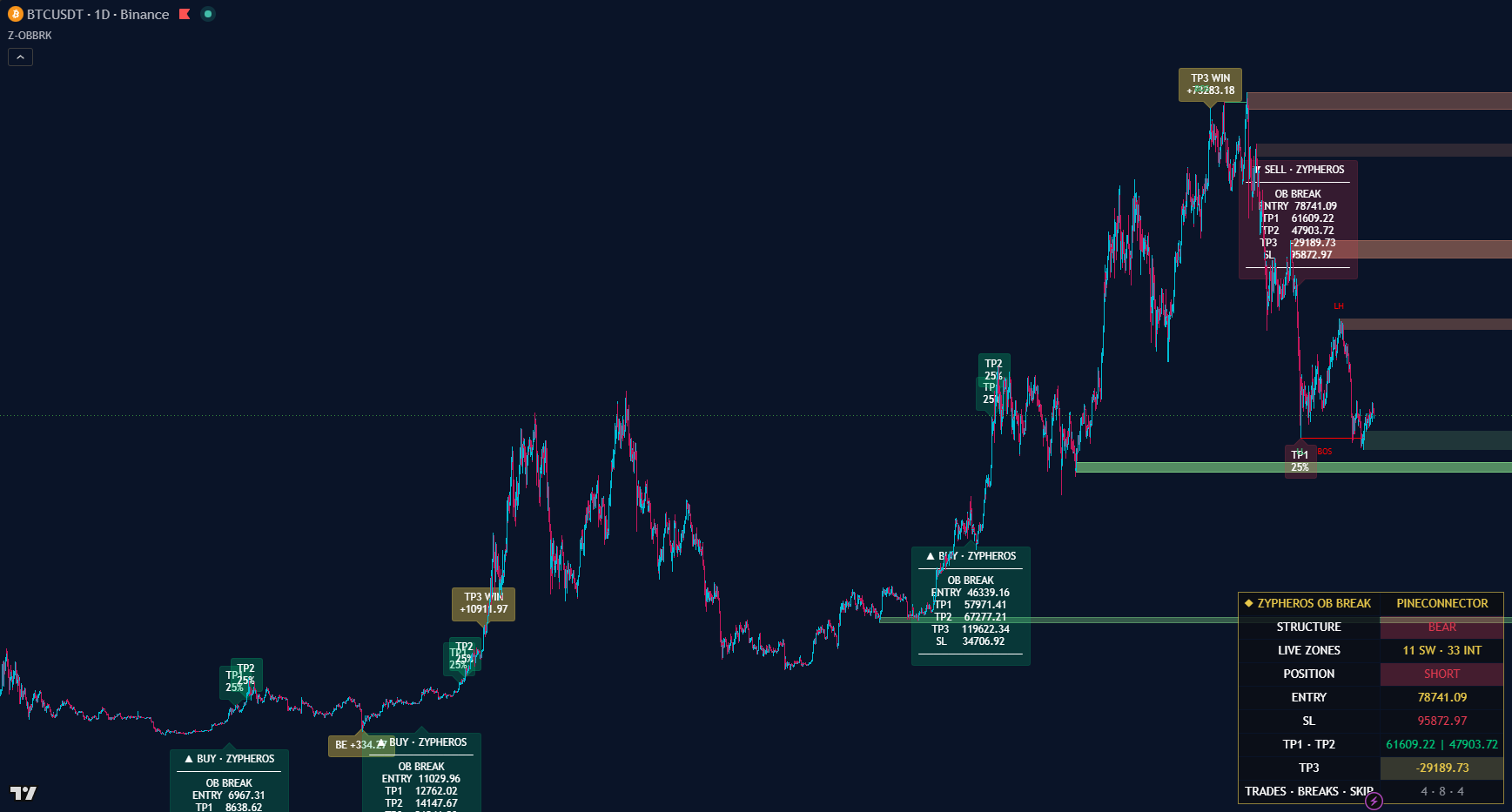
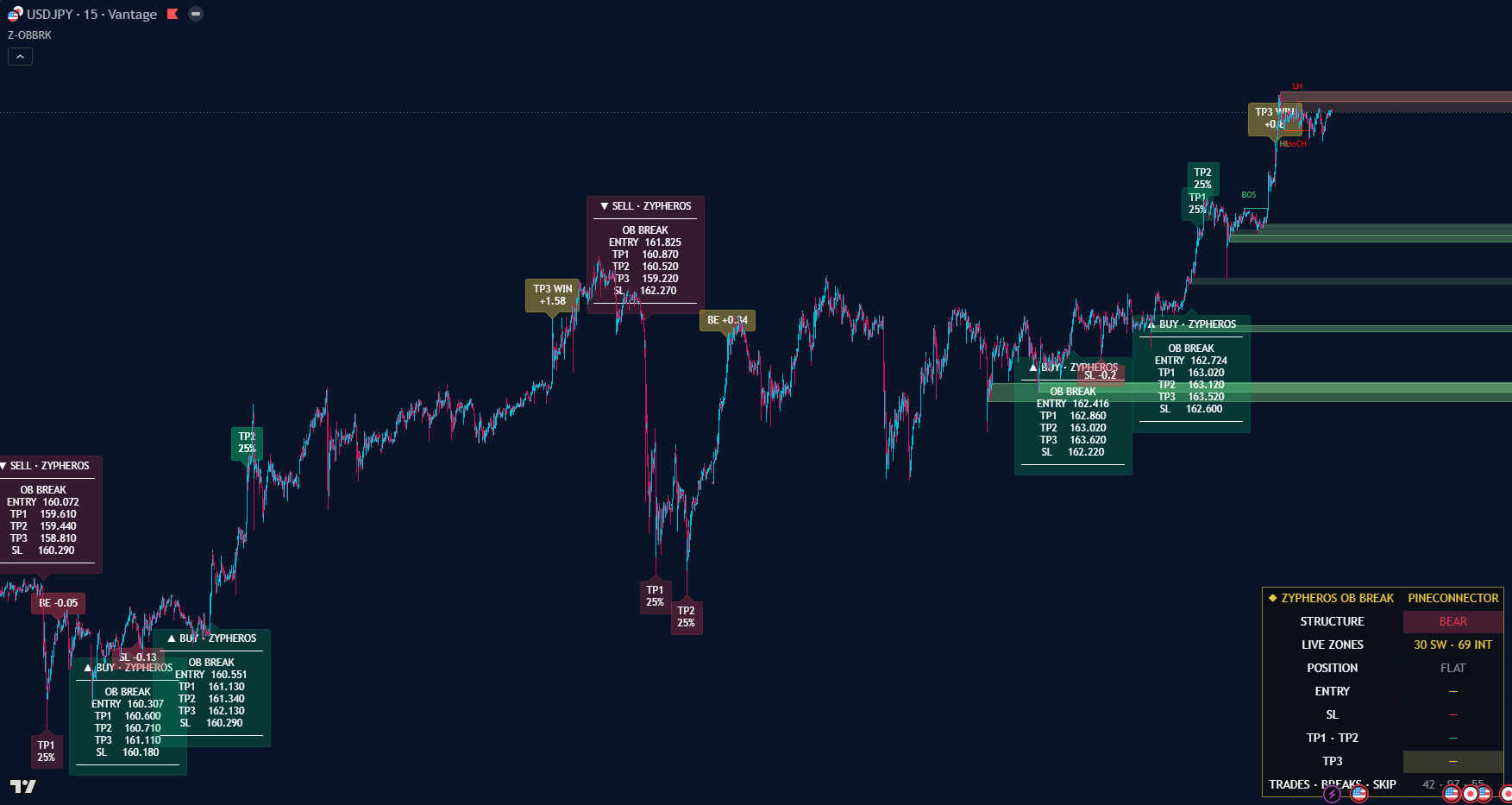
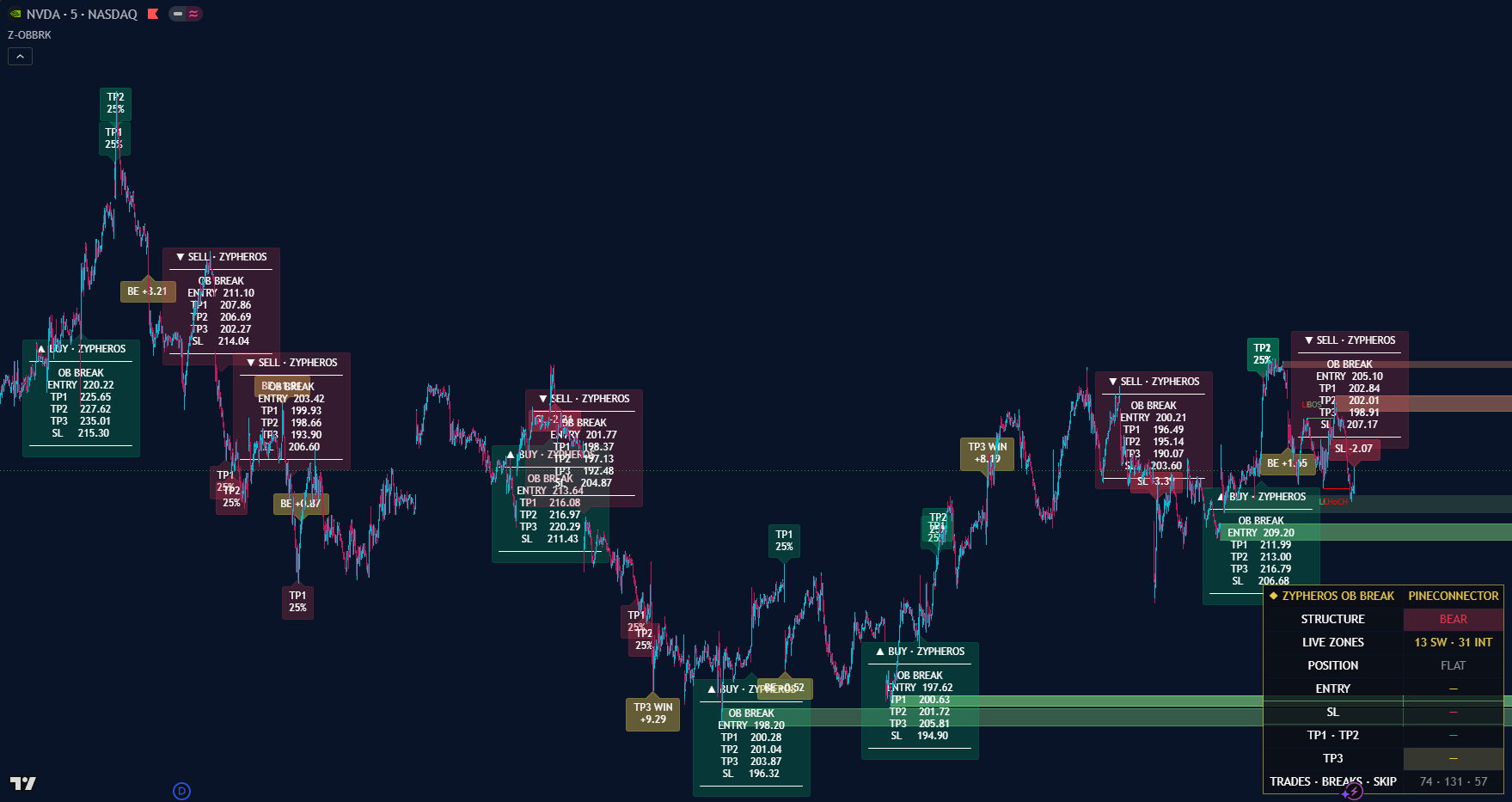
The mode is a setting, not a separate product — so a change to the structure engine reaches all three at once and they can never drift apart.
The default. A block is consumed, and the position opens in the direction of the break. One leg, one stop, no ticket paid to get there.
The textbook entry, kept so it can be measured rather than believed — with the position reversing when the block is consumed.
Long and short opened together at the same price with the same risk. The wrong side pays a fixed stop, the right side runs and accumulates as further signals arrive. Direction is never predicted.
Each degree of structure can be armed on its own, so the same instrument can run slow and clean or fast and frequent.
Entry, stop and all three targets are printed on the candle that triggered the position — and the panel keeps the running count of what was taken, what was seen, and what was refused.
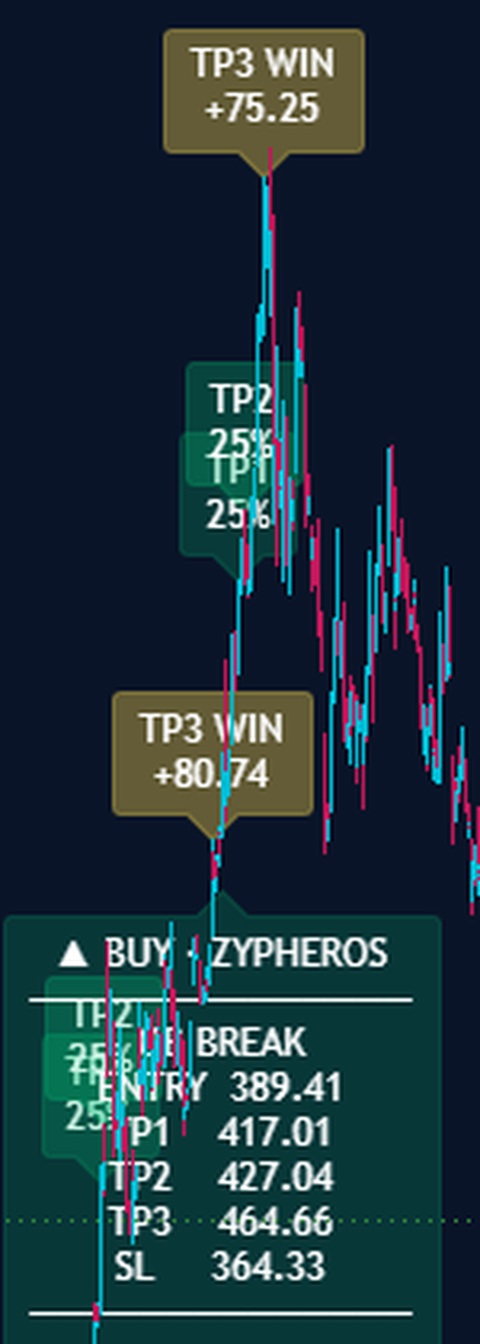
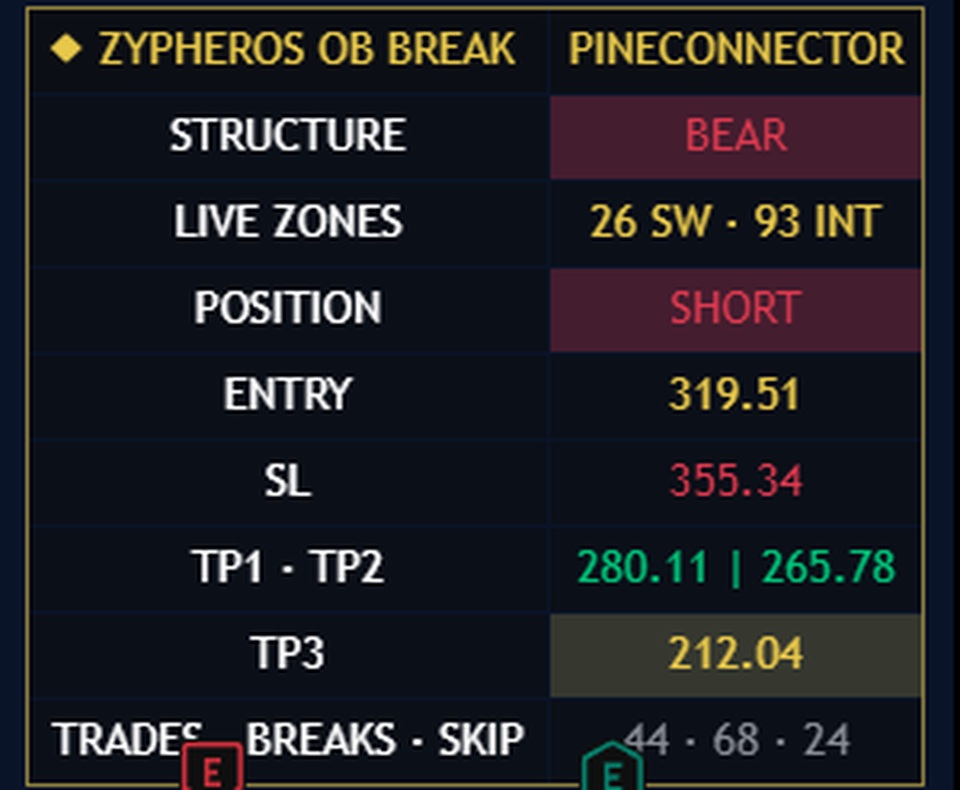
A stock, an index, a currency pair, oil, the Bitcoin daily — one unit of exposure fixed at entry, targets stacked as multiples of that same unit. The instrument changes, the volatility changes, the shape of the bet never does.
Refused, counted and displayed on the dashboard, so the cost of that rule is never hidden from you.
One position is taken and the rest are counted. Ten entries on a single impulse is not diversification.
With the trend gate armed, anything facing the wrong way is discarded regardless of how clean the break looks.
If the computed distance sits inside normal movement, the position never opens.
| Instruments | Any |
| Timeframes | 5m to daily |
| Structure | Two degrees — swing and internal, independently armed |
| Entry modes | Break · Retest · Straddle |
| Stop placement | Adaptive ATR multiple from entry |
| Target ladder | Three levels scaled from the same measured distance |
| Management | 25% / 25% / 50% |
| Execution | PineConnector alerts, separate channel per side |
| Indicators used | None beyond volatility |
| Operator input | None after arming |
Because the zone is not defended, it is consumed. The orders resting inside it are what price came for. Once they are filled the move continues — entering the zone means standing in front of it.
So it can be measured on the same data instead of argued about. A setting you can switch off is worth more than a claim.
One side carries a fixed stop and the other is left open. The arithmetic lives in the ladder, not in picking a direction.
No. Blocks are stamped on confirmed breaks and every decision is taken on a closed candle.
It runs live, every trading day, on the operator's own account — the same build, the same settings, nothing held back for a private version. Access opens in small numbers and closes again. The stream hears first.
OB BREAKER exists in both forms. Take the TradingView indicator and route it through PineConnector, or run the Expert Advisor directly in MetaTrader 4 or 5 with no chart and no bridge. The EA is a port of the indicator, not a reinterpretation of it — the same two-degree order blocks, the same break read on the closed candle, the same adaptive ATR stop and the same 25/25/50 ladder.
These are software tools, not financial advice, and nothing on this site is a recommendation, an offer or a promise of any result. Leveraged instruments are not suitable for everyone and you can lose some or all of the capital you commit. Charts shown here illustrate how the software marks a chart — they are not a performance record and past behaviour does not indicate future results. Every trading decision, and its outcome, is your own.